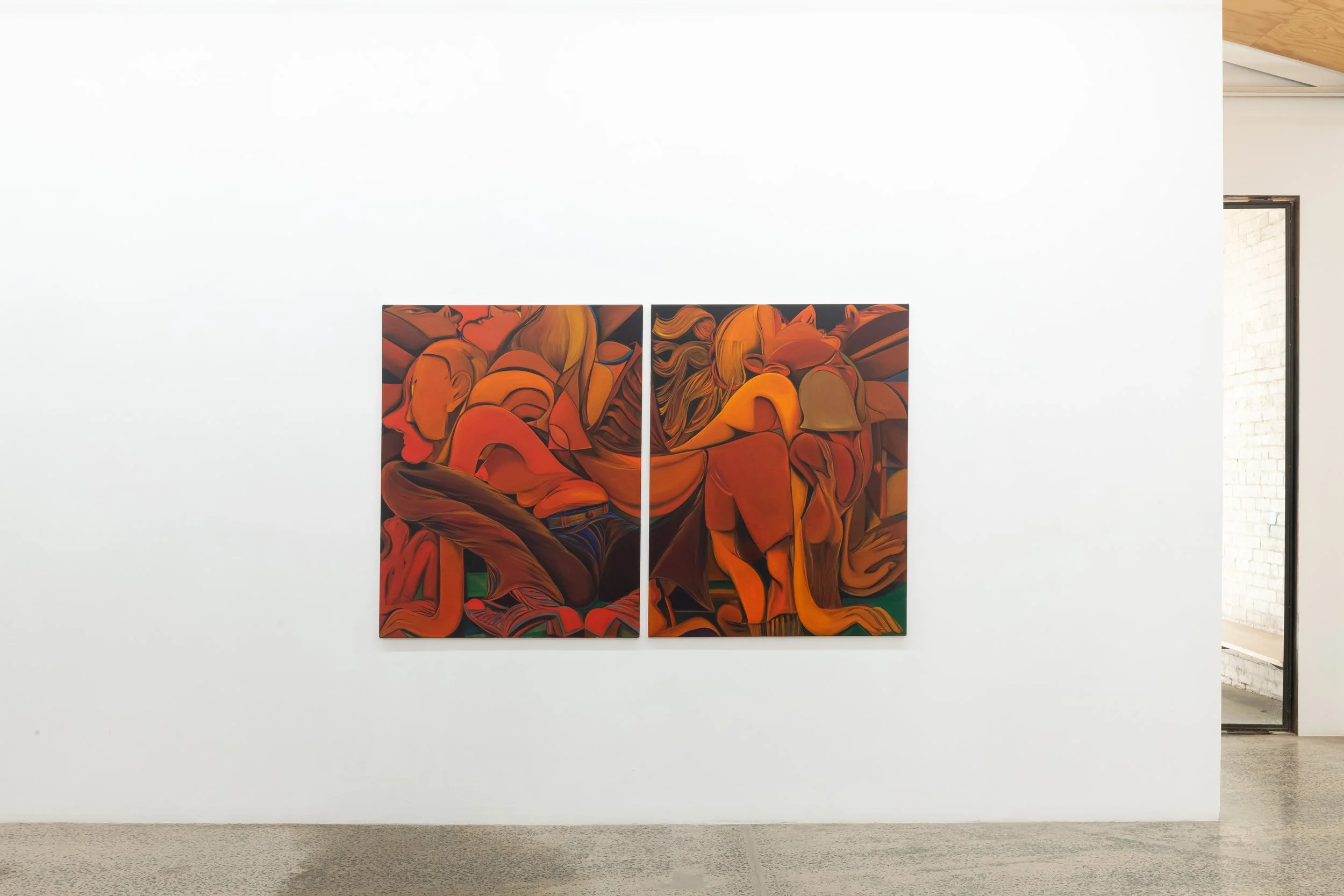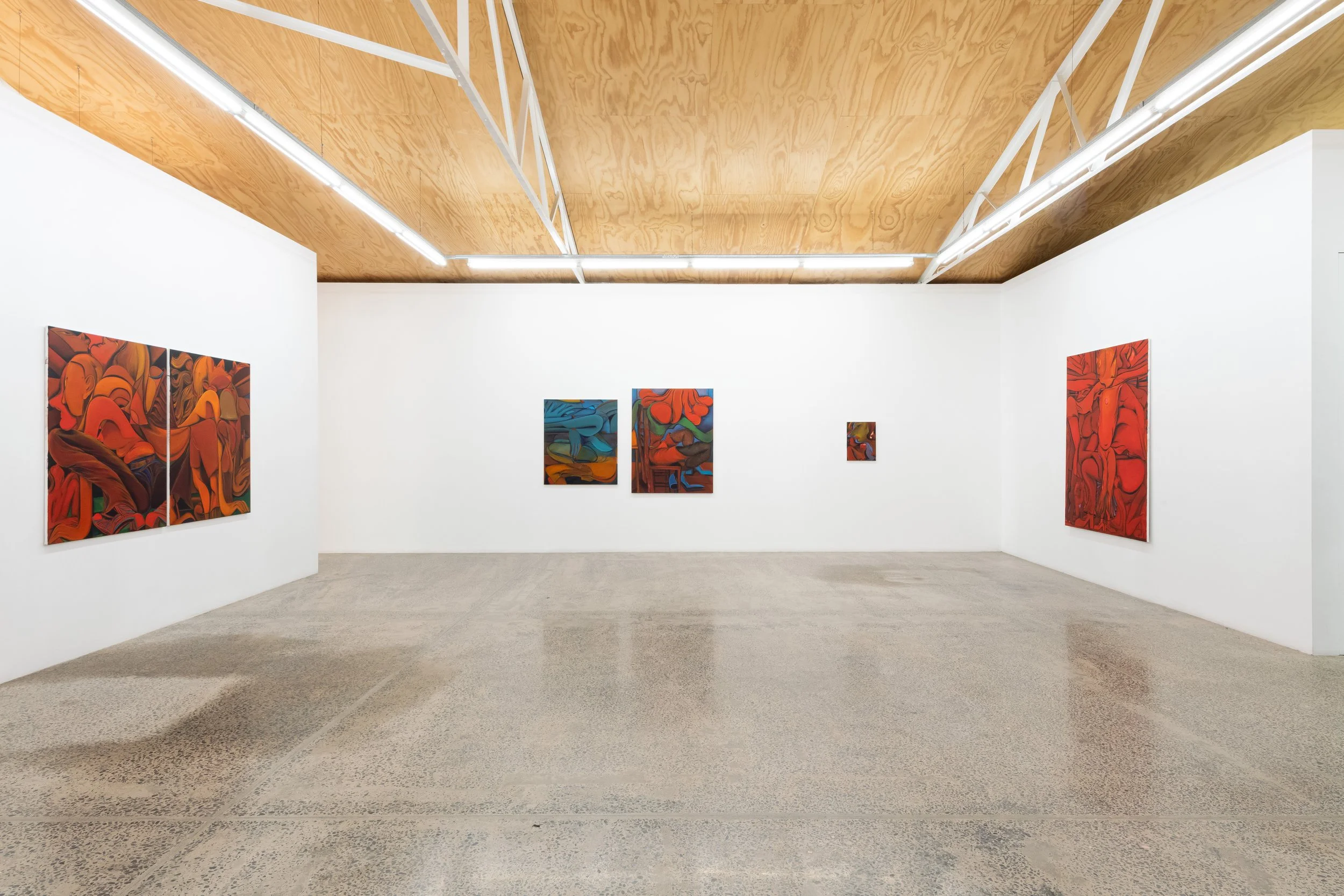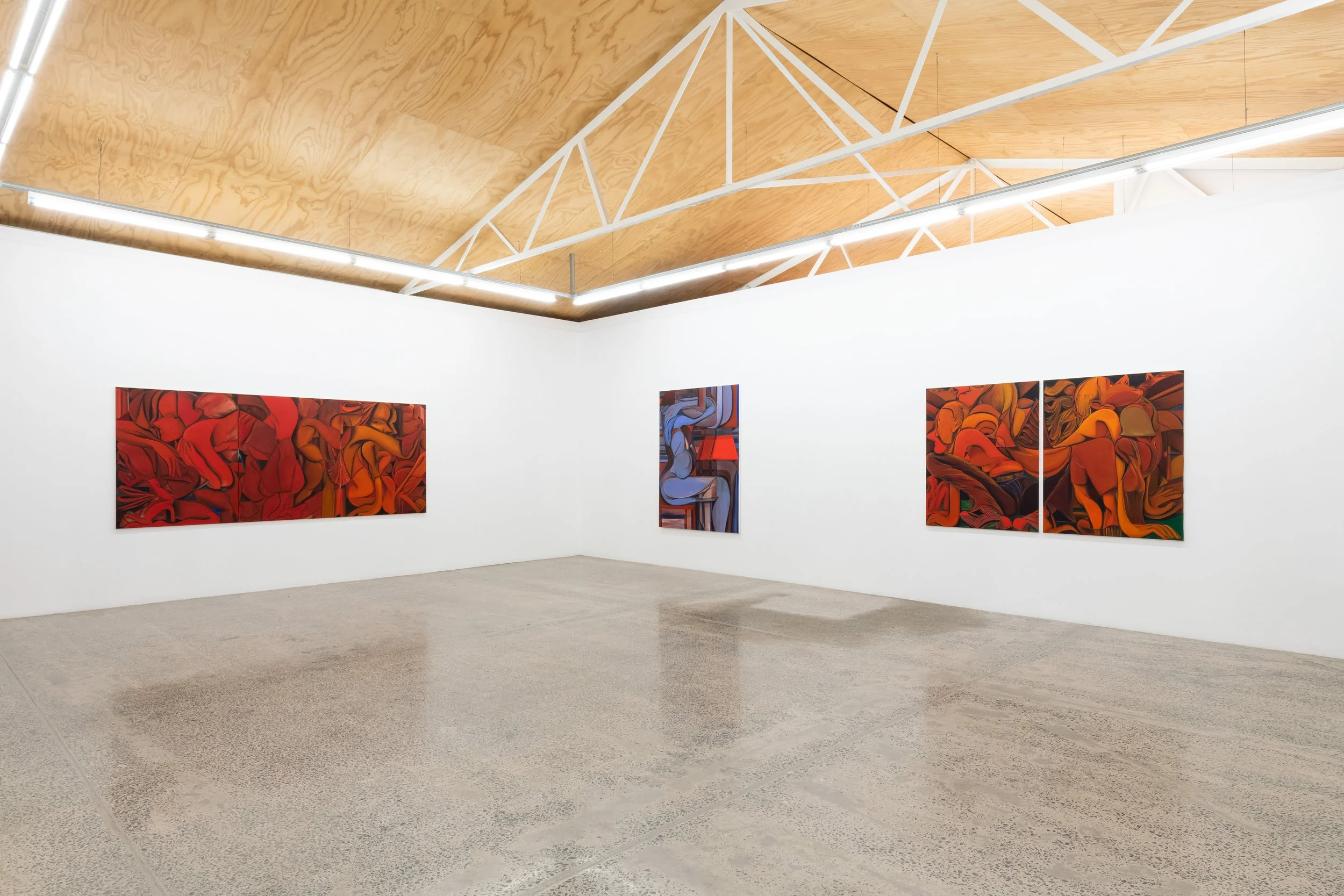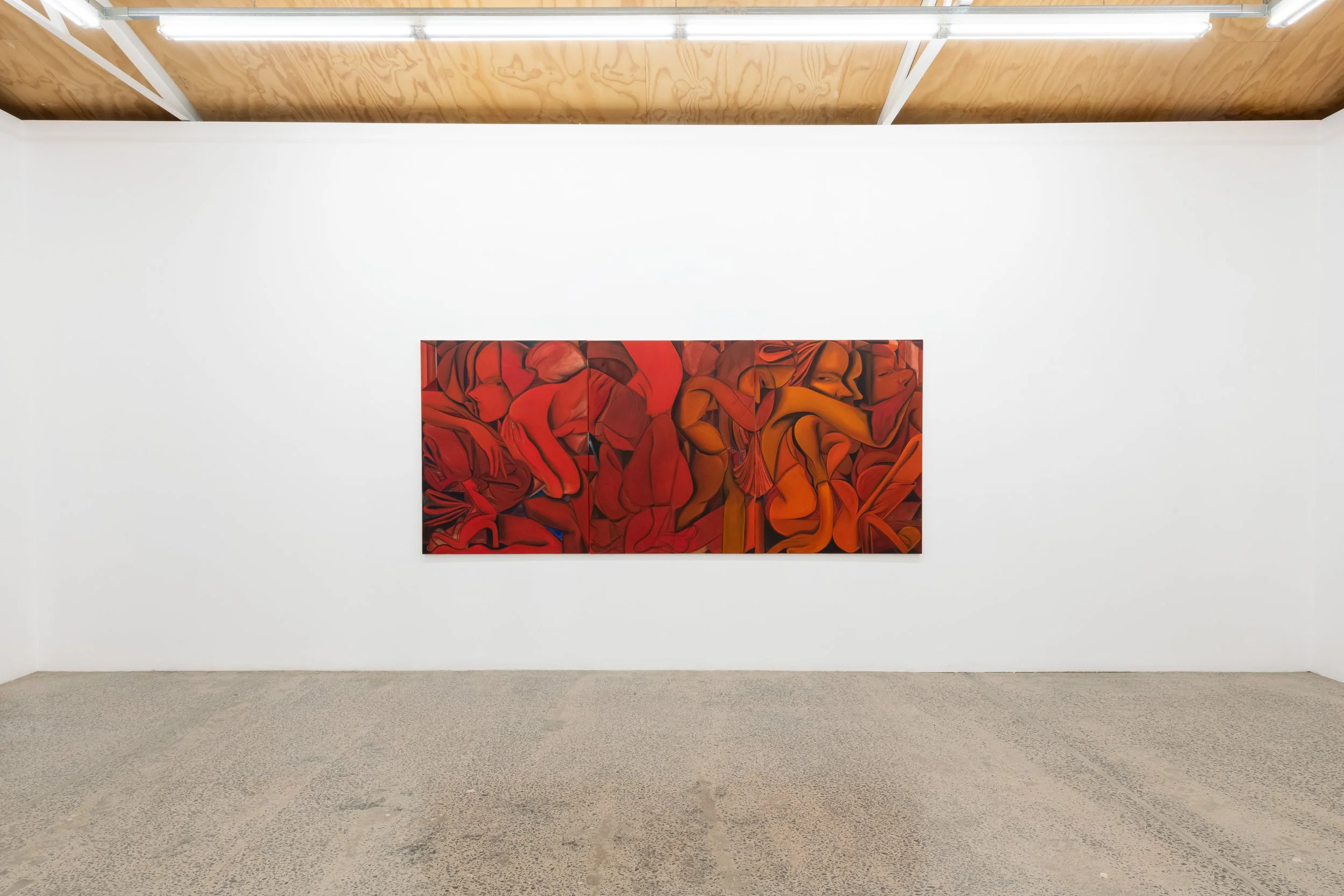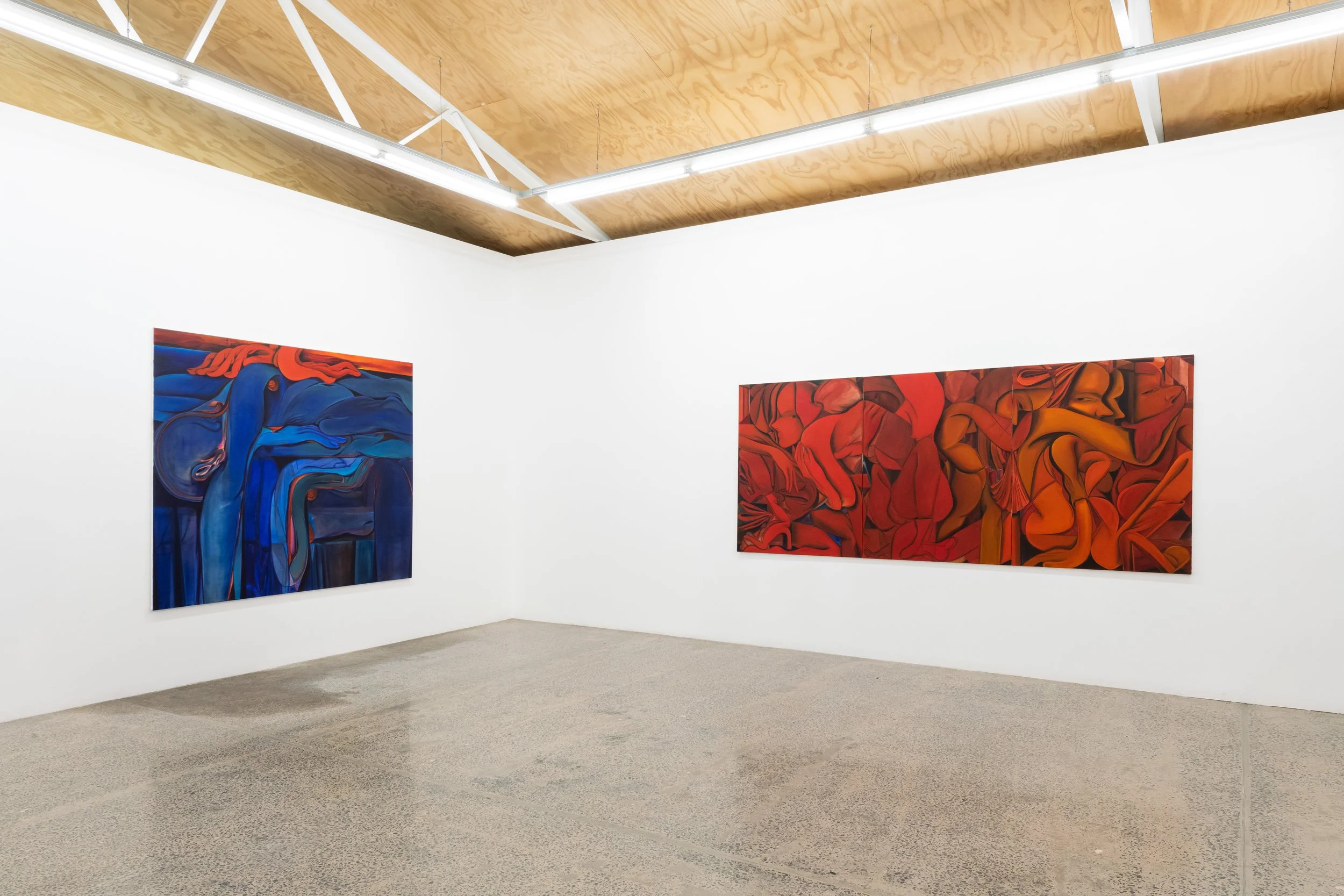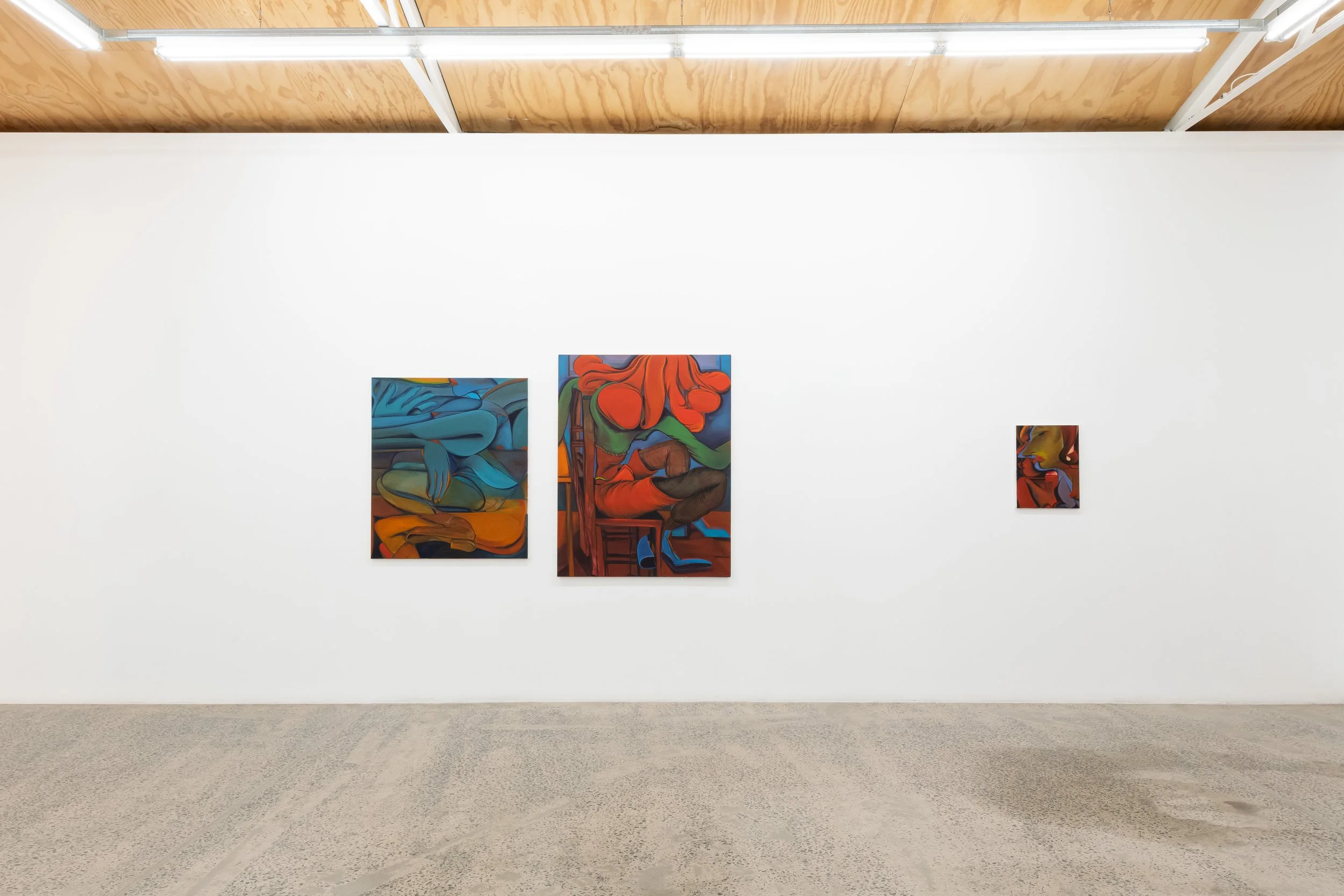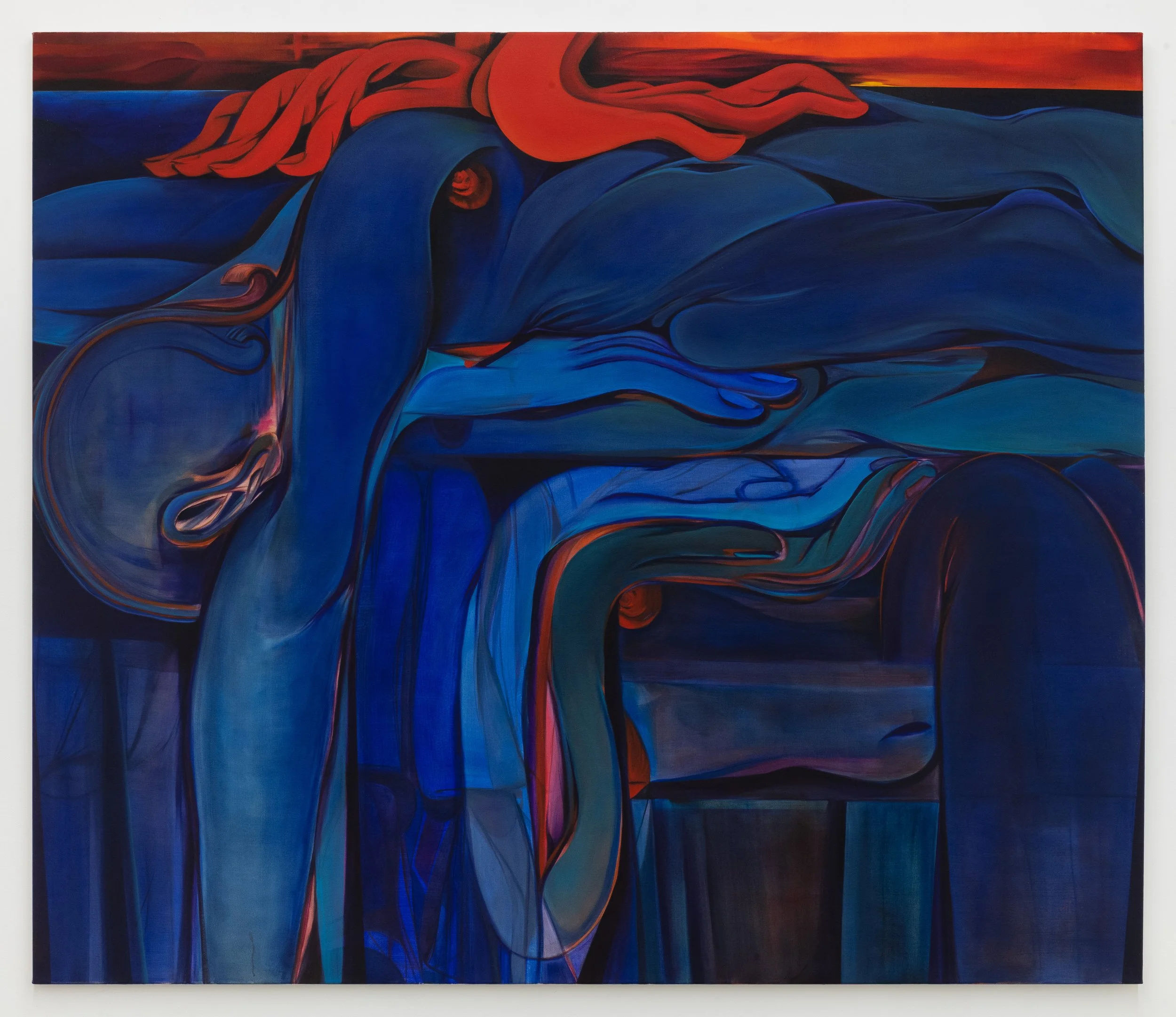
Sacred Sovereign Subject, oil on canvas, 182x214cm, 2025
Refusing the crowded allure of overt transgression or elementary eroticism, here Julia triangulates eros, containment failure, and stratification, all demanding attention as its dominant mode of encountering; yielding an intimate and visceral experience of the uncanny where ‘everything that ought to have remained hidden and secret has become visible,’ as Freud suggests.
And it is intimacy that one is confronted with here; not spectacle or excess, not voyeurism or transgression. An intimacy that is pre-symbolic—it resists infantilising the viewer with explicit narrative, spelled-out desire, or didactic morality. Meaning leaks from the canvas. Resisting the urge to convey all of its elemental forms with a simultaneous bonk on the head, disclosure is protracted steadily.
Windows and arches, doorways—these function throughout the works as psychic apertures, and as sites of permeability between the private and the public, inside and outside, where what ought to have remained hidden is revealed, but only partly. Concealment and revelation converge; do they compete or are they dialectical? Windows that don’t reveal the whole, a door ajar, a body that is there but stratified, fragmented.
In Simone Weil’s articulation of attention as transparency, it is the image of a window that elucidates how transparency and self-emptying are demanded of us so that reality can pass through unsullied by projection.
If we look through a window and see the dust on the glass, we do not see what is beyond.
If we look at what is beyond the window, we do not see the dust.
One cannot see both at the same time.
In these paintings, when the paint itself asserts itself to demand our attention, or the texture of the canvas, it may seem a moment of obfuscation of what is through the window, but instead it interrupts transparency and the impulse to look through, holding attention at the surface and in the act of seeing itself. Where Weil implies a choice between the dust on the glass or what lies outside the window, Julia’s works suggest a synthesis where what is depicted through the window is never fully decipherable, legible, or whole, and the surface—the canvas and brushstrokes of the paint—is never entirely absent.
Displaced and averted gazes complicate such an economy of attention. Reciprocal attention and desire mostly evade the viewer, as glances are exchanged laterally, exchanged between one fragmented body and another. René Girard’s conceptualisation of mimetic desire understands desire as never individual, autonomous, or innate, but inextricable from and mediated by other desiring beings. We do not want what is desired, only what is desired by another. Julia’s painted bodies, as are you, desiring viewer, are caught up in such a libidinal spiral—and there’s bad news: consummation, realisation, and clarification are not forthcoming.
When Deleuze notices the averted gaze of Francis Bacon’s distorted figures, he insists that the failure to meet the gaze is the preservation of feeling. When we meet the gaze of the painted subject, identification forms, empathy begins to pool, and sensation gives way to interpretation and symbolic meaning. For Lacan, the denial in an unmet gaze is of the fantasy of mutual recognition that underpins voyeurism. Vision here operates like the windows that reoccur throughout the works, teasing something to be obtained, yet access remains withheld.
The suspicion that identity can be understood more faithfully not through recognition, but through its failure, becomes manifest here. Cherub in a Cage depicts a head unfurling into a series of one repeating and becoming many; identity is both fragmented and expanded, and universal, assuming a mythic and polymorphic logic. She, like the other portrayed subjects, is as the many-headed depictions of Shiva or Brahma of the Hindu faith—many and one, personal and impersonal. Unity is redistributed rather than denied. From each, to each.
The bodies themselves hunch and slump, slouching towards nowhere in particular. They are lumped together, both supporting and competing. They bear weight; they aspire toward grace despite the downward pull of gravity. Feet especially bear weight, and consistently emerge as points of pressure and stabilisation, perhaps of vulnerability. Hands occur with similar emphasis, but establish a contrasting metaphorical value; a hand acts, a hand controls.
Across the paintings, the bodies shift. Bodies that were hunched and slumped inward, resigned to gravity and apathetic to grace, finally unfurl; but even when fully extended, they are denied independence, transcendence, or salvation. To finally stand straight is not to be free, but to feebly depend on other bearing bodies, and to know it, even if those bodies are obscured to the point of expenditure. Grace that was met with indifference is now met with reluctance, even regret.
Julia is emphatic on the thematic significance of hierarchy, where power is only relational and all ascent requires domination, and one look will undoubtedly yield such a reading. A first glance might find a Hobbesian war of all against all—pyramidal logic, spectacle, or barbarism? But look again, now, and see not competition but structural dependence, where bodies are, as the self is, held together provisionally and preventing collapse despite the inevitability of ultimate annihilation.
No resolution is found or offered. Bodies bear constant weight, gaze is averted endlessly, identity is never whole, and desire is defined as it is lived—by absence. What is offered is resolutely anti- teleological. A radical refusal to make a promise of completion or consummation that cannot be kept in a world saturated in and sustained on such promises and the fantasies that legitimise them. We are left with a reckoning—with what bears down, with selves that do not cohere, with partiality, precarity, and impermanence.
- Cam Ainsworth
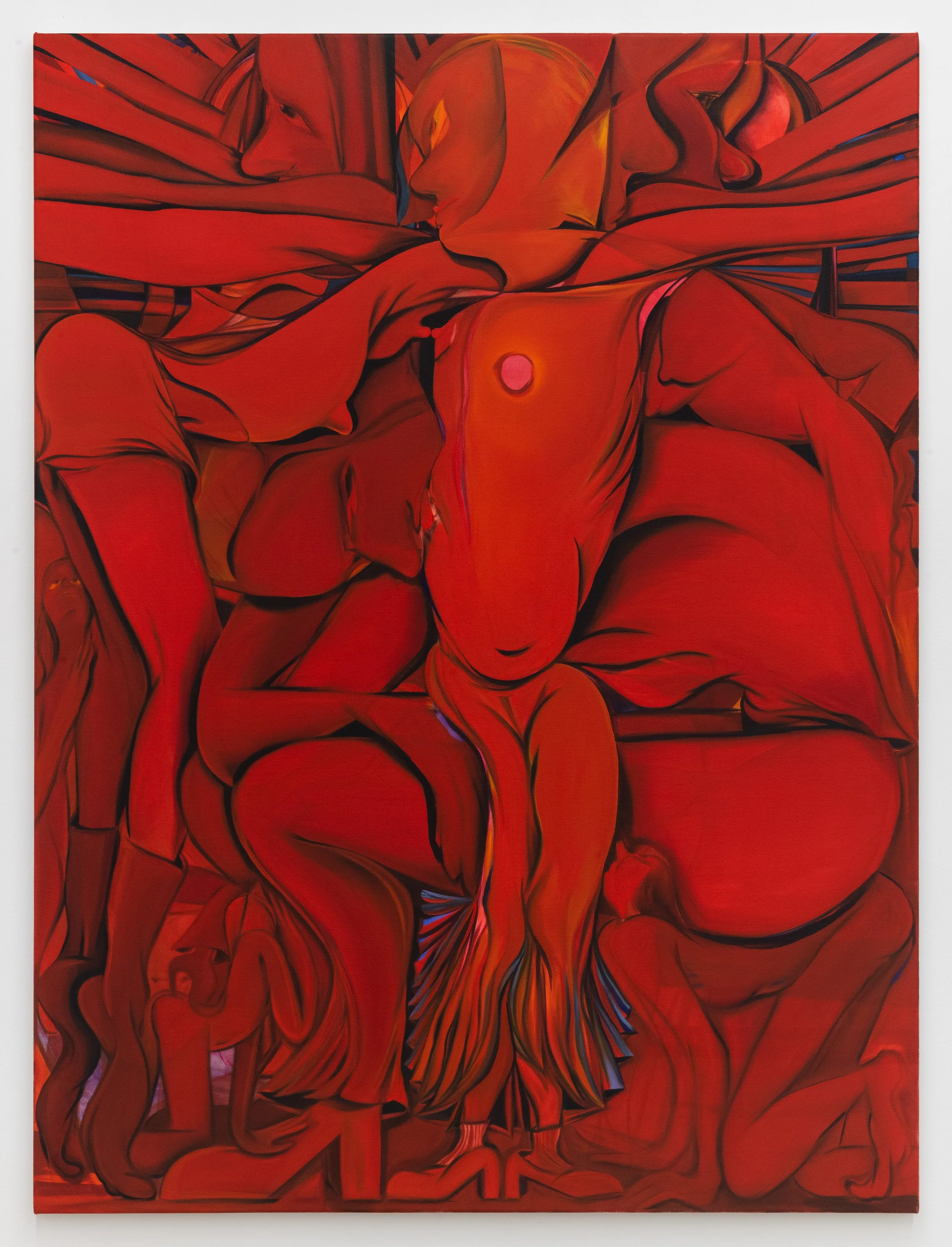
Cherub in a Cage, oil on canvas, 182x137cm, 2025
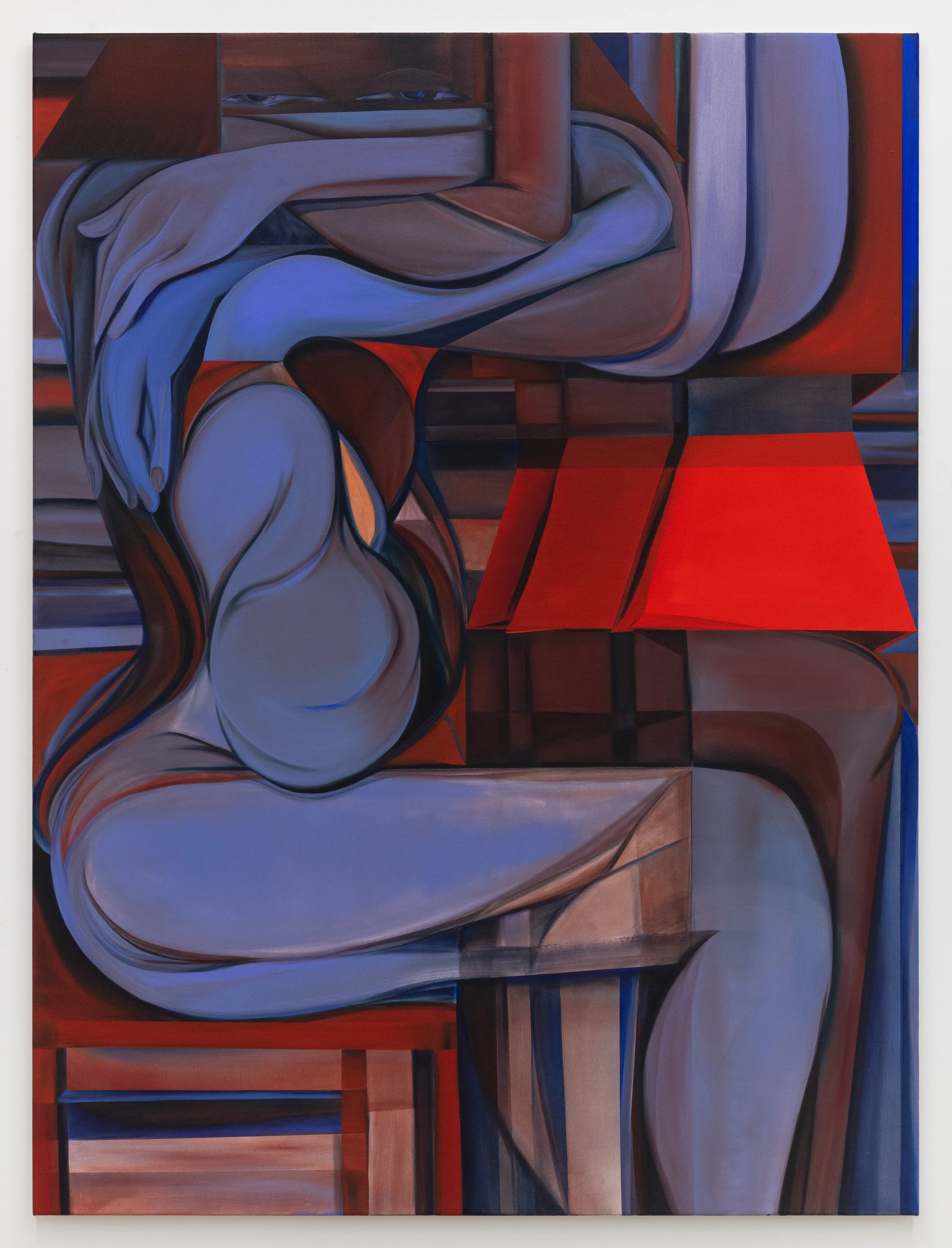
Peace Seat, oil on canvas, 182x137cm, 2025
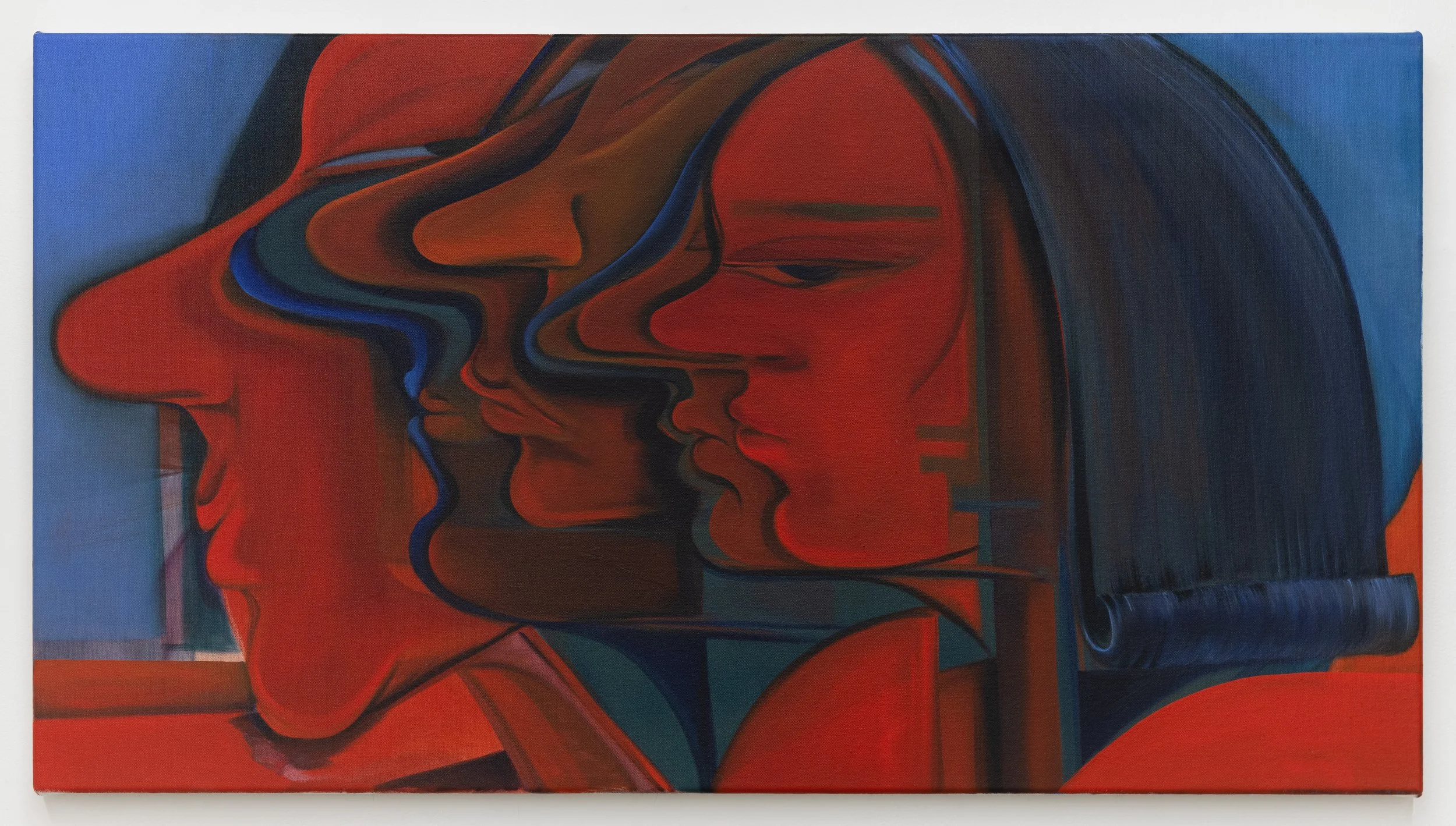
Escitalopram Logo, oil on canvas, 60x112cm, 2025
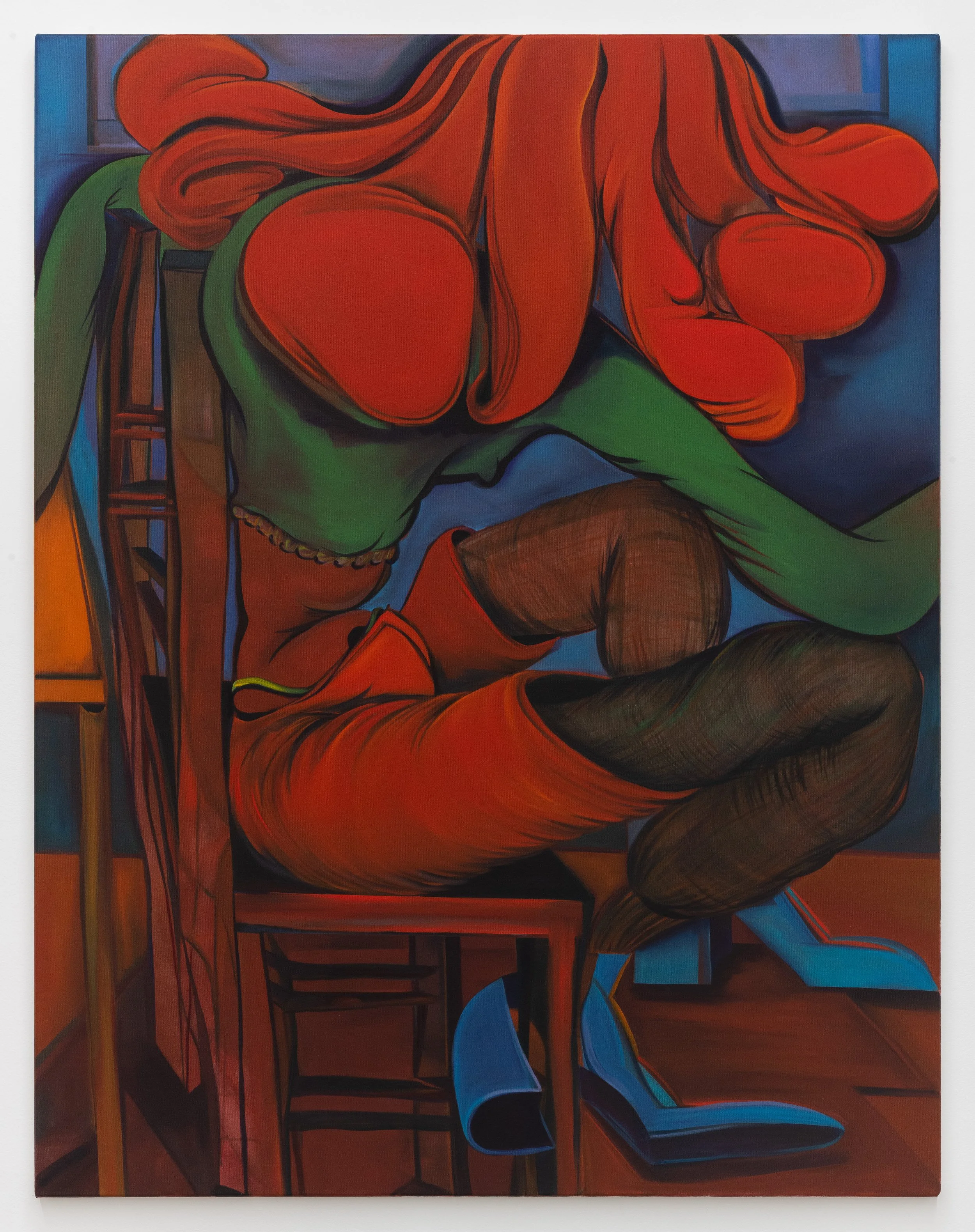
Stabilisation, oil on canvas, 137x107cm, 2025
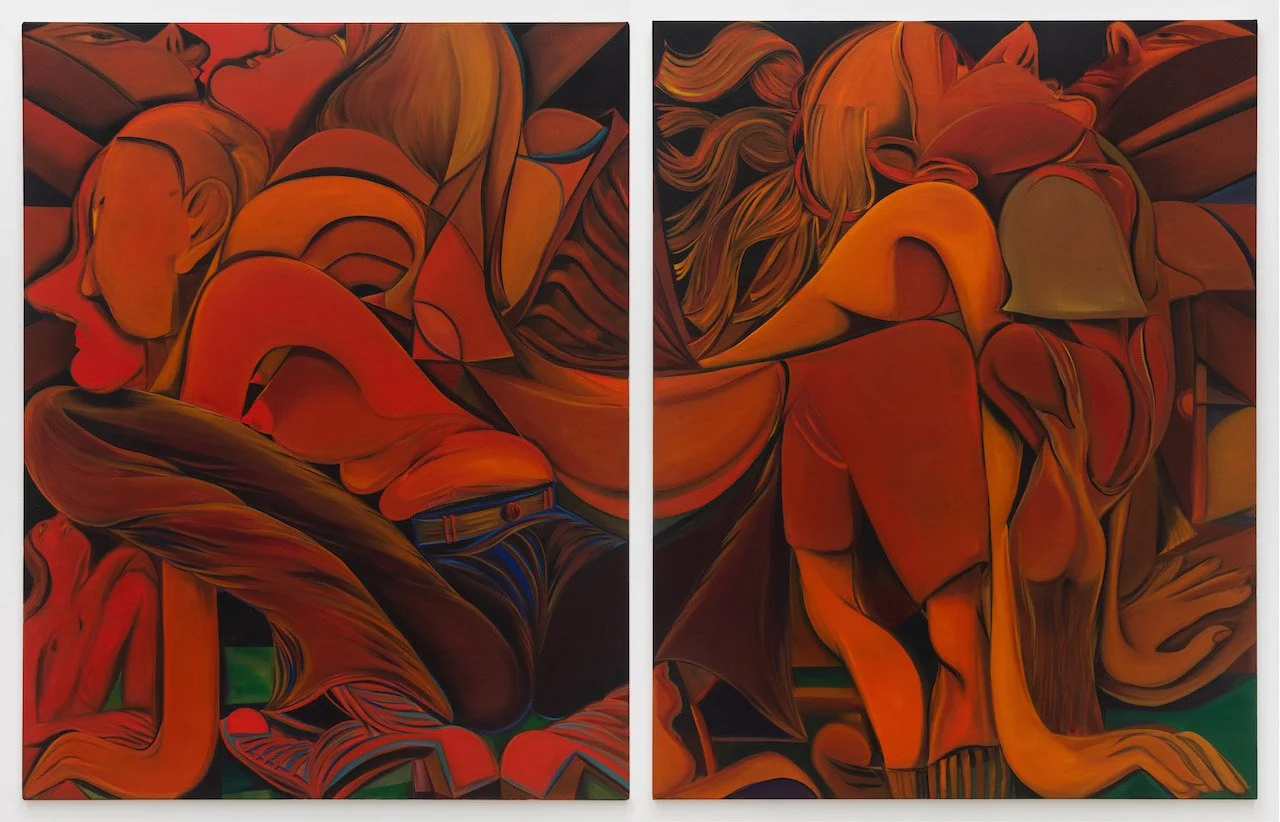
If Love is the answer you’re home (diptych), oil on canvas, 137x107cm, 2025
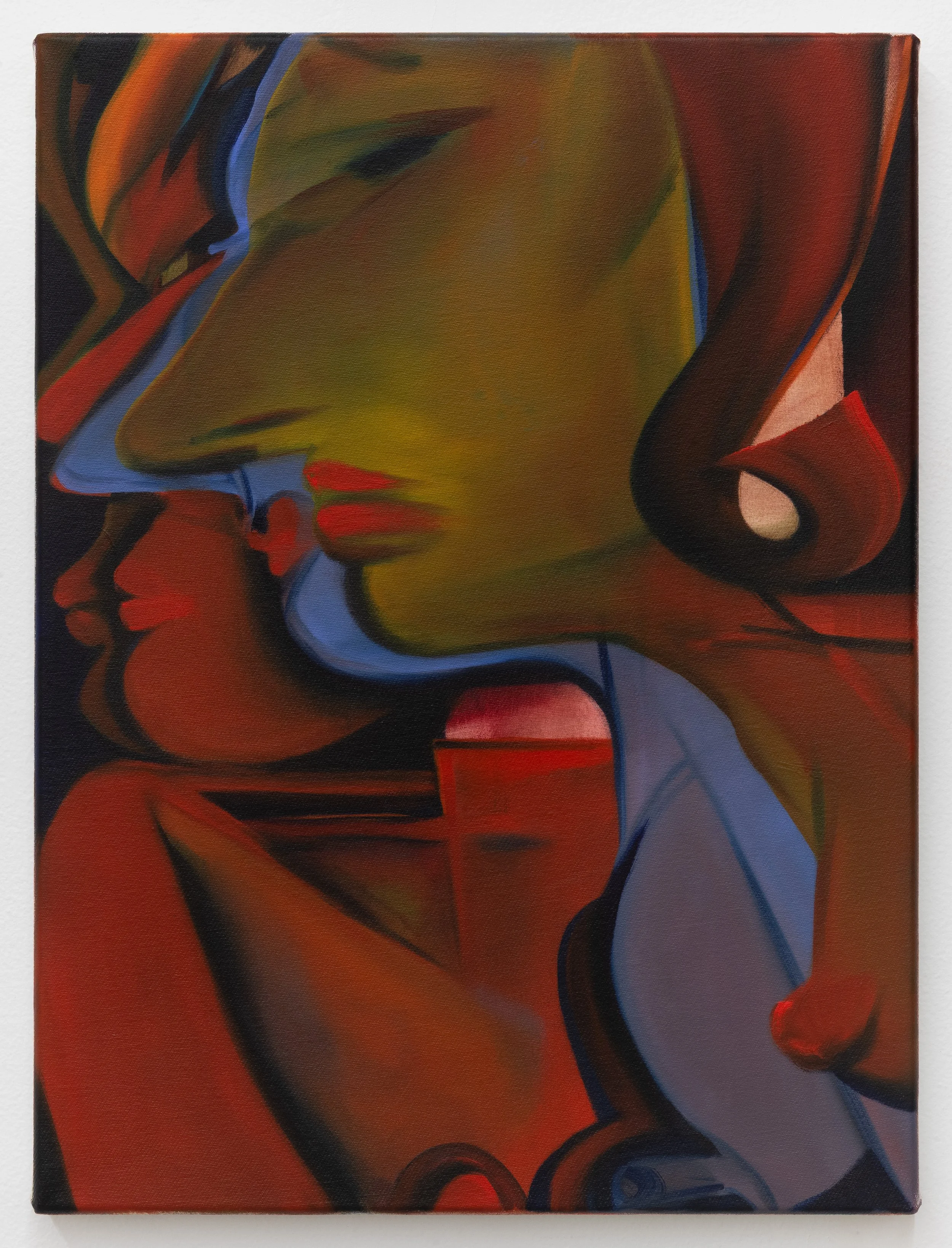
Self Portrait, oil on linen, 51x38cm, 2025
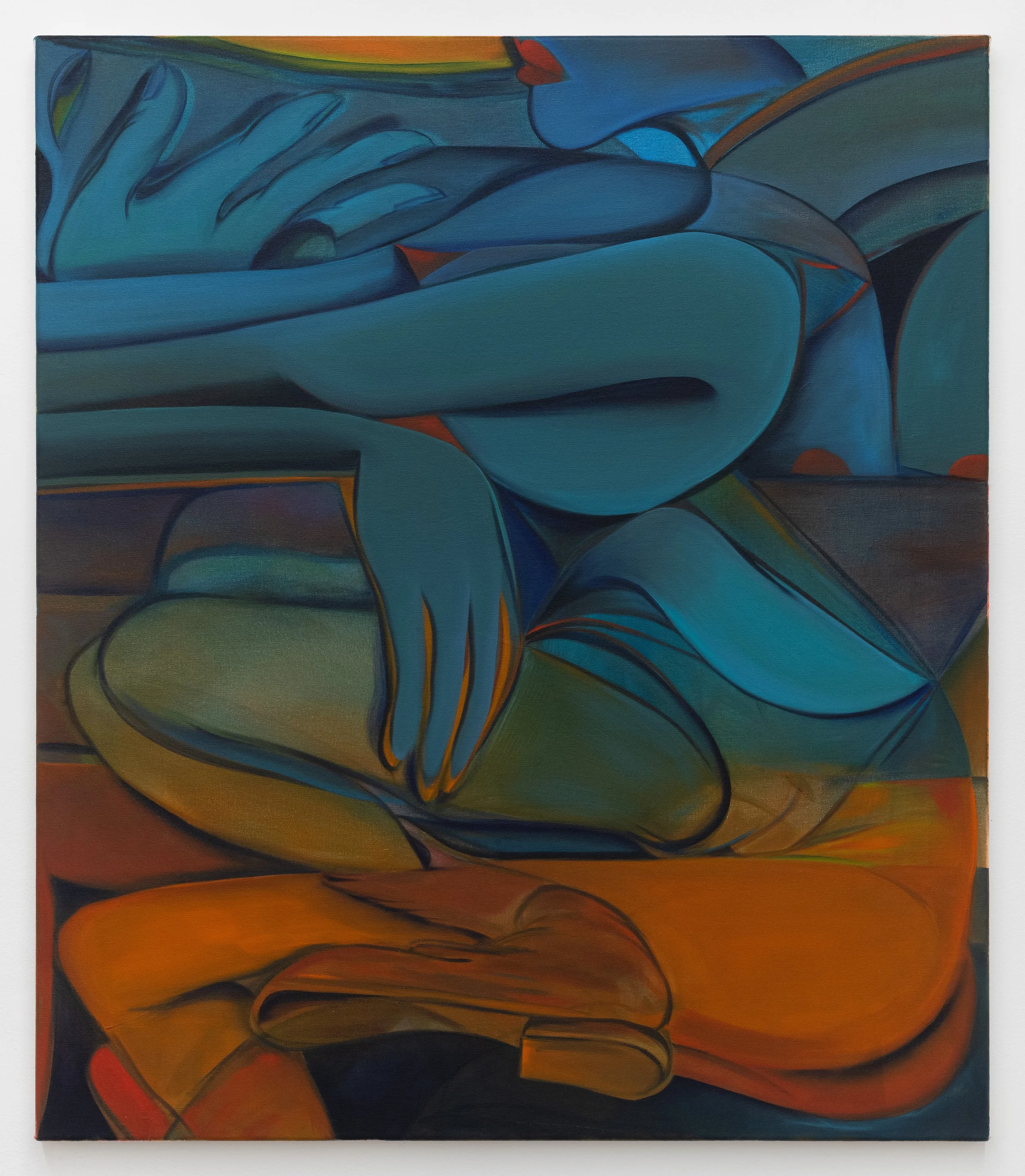
Crutch, Boot, Kiss, oil on canvas, 112x97cm, 2025